
Sliding Scale Pricing
An equity tool, not an afterthought.
Sliding scale is an important equity tool that allows for access to a service at multiple price points based on circumstances.
I offer a sliding scale as a way to support various communities in accessing the support they want and deserve.
It works on the honor system: you're welcome to self-select whichever tier fits your circumstances. Every service is priced across four tiers — Solidarity is the full rate, Community is the most subsidized. You can see the exact pricing for each tier on the Services page.
How to find your rate
- Read through the four descriptions below and find whichever sounds most like your current circumstances.
- Match it to a tier: Solidarity, Sustaining, Supported, or Community.
- Look up your tier's exact price for the service you want on the Services page.
- Send a request whenever you're ready — you don't need to explain or justify which tier you picked.
Where do you fall on the scale?
The Green Bottle Model
I base my sliding scale on the Green Bottle Model, created by Alexis J. Cunningfolk. It maps onto my four pricing tiers like this: Bottle 1 = Solidarity, Bottle 2 = Sustaining, Bottle 3 = Supported, Bottle 4 = Community.
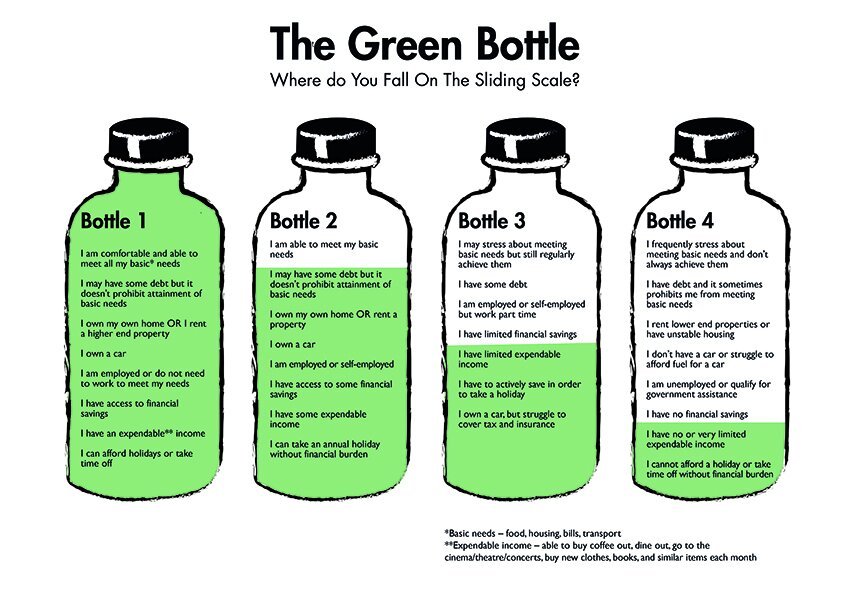
Bottle 1 (Solidarity)
- I am comfortable and able to meet all my basic needs*
- I may have some debt but it doesn't prohibit attainment of basic needs
- I own my own home OR I rent a higher end property
- I own a car
- I am employed or do not need to work to meet my needs
- I have access to financial savings
- I have an expendable** income
- I can afford holidays or take time off
Bottle 2 (Sustaining)
- I am able to meet my basic needs
- I may have some debt but it doesn't prohibit attainment of basic needs
- I own my own home OR rent a property
- I own a car
- I am employed or self-employed
- I have access to some financial savings
- I have some expendable income
- I can take an annual holiday without financial burden
Bottle 3 (Supported)
- I may stress about meeting basic needs but still regularly achieve them
- I have some debt
- I am employed or self-employed but work part time
- I have limited financial savings
- I have limited expendable income
- I have to actively save in order to take a holiday
- I own a car, but struggle to cover tax and insurance
Bottle 4 (Community)
- I frequently stress about meeting basic needs and don't always achieve them
- I have debt and it sometimes prohibits me from meeting basic needs
- I rent lower end properties or have unstable housing
- I don't have a car or struggle to afford fuel for a car
- I am unemployed or qualify for government assistance
- I have no financial savings
- I have no or very limited expendable income
- I cannot afford a holiday or take time off without financial burden
*Basic needs – food, housing, bills, transport
**Expendable income – able to buy coffee out, dine out, go to the cinema/theatre/concerts, buy new clothes, books, and similar items each month
This chart is sourced from northernbirthwork.com (opens in a new tab). The Green Bottle Model concept is by Alexis J. Cunningfolk — read more about sliding scale pricing at wortsandcunning.com (opens in a new tab), or at the Radical History Club (opens in a new tab).
Still not sure where you fall? Those two links go deeper, or you can just reach out and we'll figure it out together.